Dr. Gymbro
←

#randomized controlled trial

2 articles
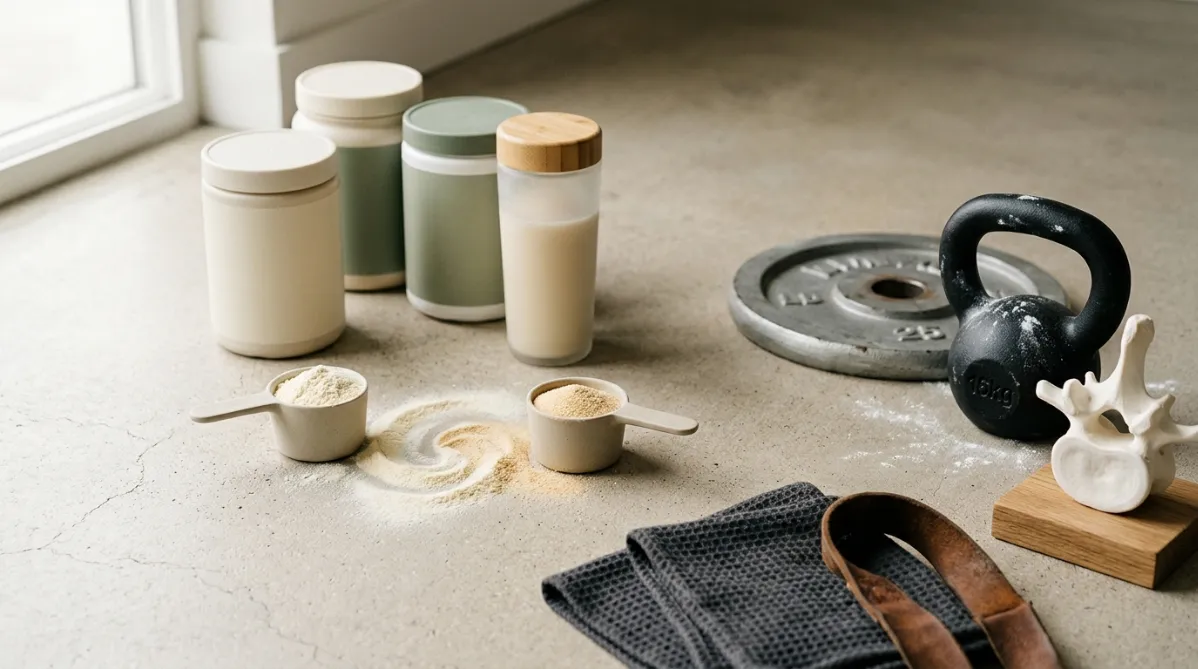
A wide, softly lit editorial still life on a pale warm-gray concrete surface, shot from a slightly elevated three-quarter angle. In the center-left, two matte ceramic scoops sit side by side. One holds fine ivory whey powder, the other holds slightly coarser, pale golden collagen peptide powder. A small, elegant dusting of both powders spills between them and blends into a soft swirl. Behind them, three minimalist cream and sage-green supplement tubs with no legible text stand in a staggered row, with a frosted glass shaker bottle of creamy liquid beside them.

On the right, a brushed-steel barbell plate and a compact chalk-dusted kettlebell rest slightly out of focus, suggesting resistance training. Pale wisps of chalk hang in the air. A folded charcoal gym towel and a pair of worn leather lifting straps lie in the foreground. A single cross-section of a clean white bone model, a stylized vertebra, rests on a small oak block at the far right. It subtly signals the bone-density theme without looking clinical.

Natural window light enters from the left, casting long, gentle shadows and a warm highlight on the powders. The palette is muted and modern: oatmeal, bone white, sage green, soft charcoal, and touches of warm amber. Shallow depth of field keeps the scoops tack-sharp and melts the background into creamy blur. Leave generous negative space in the upper right for headline overlay. The overall feel is a premium health and science journal cover: clean, tactile, minimalist, with fine film-like grain and a calm, editorial mood.
nutrition

Le whey + collagène surpasse les deux séparément chez les bodybuilders — mais il y a un piège

BY DR. GYMBRO ·

Mélanger 30 g de whey avec 10 g de collagène a fait mieux que la whey seule, le collagène seul ou le placebo sur tous les paramètres mesurés dans un essai de huit semaines chez des hommes entraînés en musculation. Cette association a ajouté 2,66 kg de muscle (BIA), a accru la densité minérale osseuse lombaire et a amélioré le squat, le développé couché ainsi que les marqueurs de remodelage osseux. Le collagène seul a eu un effet sur les os, la whey seule sur le muscle. Mais avec seulement 40 participants, des apports protéiques inégaux et une hausse de densité osseuse inattendue, il faut rester prudent.
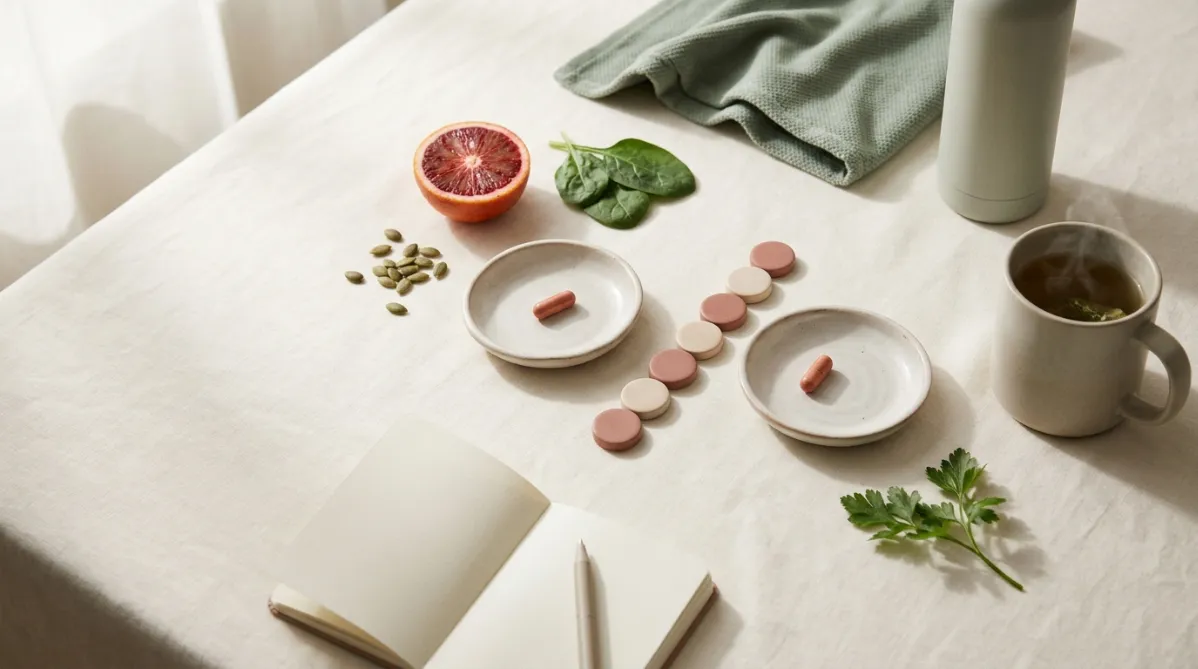
A bright, airy editorial flat-lay shot from slightly above, on a soft warm-white linen surface with gentle natural window light and long, soft shadows. Two small ceramic dishes sit side by side at the center. The left dish holds a single small capsule in muted terracotta. The right dish holds one small capsule in the same color, with a noticeable empty space beside it to suggest rhythm and spacing. Between them lies a minimalist wooden calendar block or a row of seven small round ceramic discs in alternating tones, dusty rose and cream, evoking an every-other-day pattern. Around the dishes are fresh, iron-rich foods arranged with restraint: a halved blood orange, a few deep green spinach leaves, a small scattering of pumpkin seeds, and a sprig of parsley. A folded sage-green athletic towel and a slim, modern water bottle sit at the upper edge, hinting at women who train. A matte ceramic mug of herbal tea sits at the right with a faint curl of steam. A small notebook with a pen lies open at the lower left, its pages blank, suggesting lab results and tracking without any legible text. The palette is soft and cohesive: warm cream, dusty rose, terracotta, sage green, with small accents of deep coral. The mood is calm, clean, and wellness-oriented, like a contemporary health and science journal feature. Shallow depth of field keeps the capsules sharp and softly blurs the edges of the frame. The composition leaves generous negative space on the left third for title overlay. The look is a high-end lifestyle photograph with subtle film grain, natural textures, and refined minimalism, with no people, no text, and no futuristic or laboratory elements.
nutrition

Moins de fer, tous les deux jours : mêmes gains de ferritine chez les femmes

BY DR. GYMBRO ·

L’hépcidine limite l’absorption du fer après chaque prise, ce qui explique souvent la mauvaise tolérance du fer oral. Un essai randomisé de 2026 portant sur 66 femmes carencées a comparé 21 mg de fer tous les 48 h à 30 mg par jour pendant 42 jours. La ferritine a augmenté de façon significative dans les deux groupes, sans différence notable, tandis que l’hémoglobine est restée stable et les effets gastro‑intestinaux étaient légers. L’étude était active‑contrôlée (pas de placebo) et les deux formes de fer étaient différentes, ce qui rend la comparaison prudente. Voici ce que cela signifie pour les sportives et pourquoi il faut mesurer la ferritine avant de se supplémenter.

This page is available in